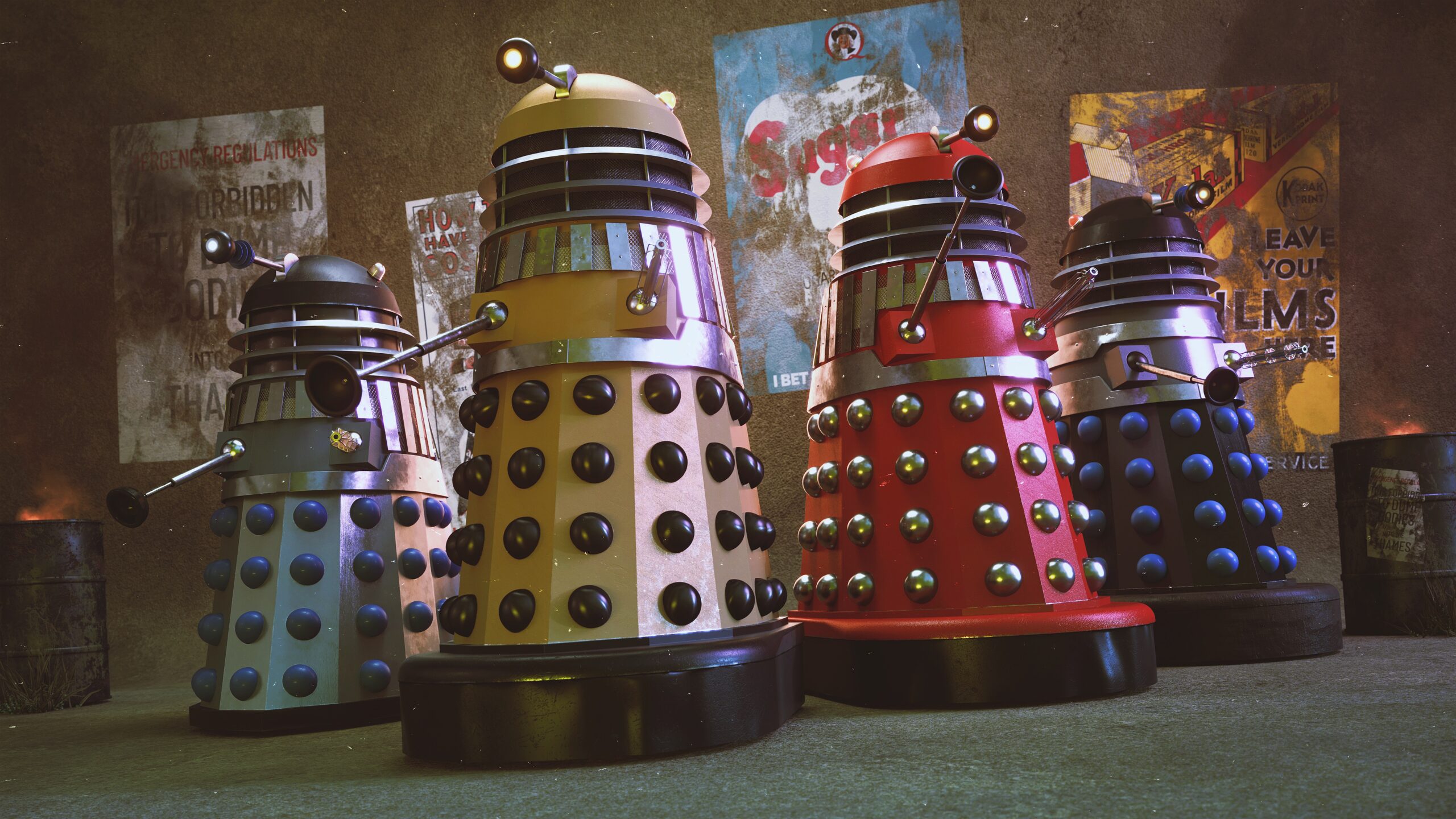
Big Finish’s early Doctor Who output is sometimes looked back on as experimental, a company finding its footing, but The Genocide Machine is where they take a confident step into the Dalek-infested waters and come up with something cracklingly good. It’s one of those releases that feels not just like a continuation of televised Who, but an expansion of it – broadening the canvas, tightening the atmosphere, and giving the Doctor’s most infamous enemies more room to breathe (and exterminate).
Mike Tucker knows his Daleks. This isn’t a lazy “wheel them out, shout EXTERMINATE, job done” affair. Instead, he leans into their social order, the hierarchy of drones, commanders, and that looming Special Weapons Dalek, reminding us that the pepperpots are as much a society as they are a war machine. There’s always been something chilling about how the Daleks organise themselves – obedient soldiers funnelling into rank and file beneath shrieking leaders – and here that sense of disciplined fanaticism is sharpened into a scalpel. The Daleks don’t just want to win; they want to build, conquer, and rewrite reality in their image.
The Seventh Doctor is at his most scheming here, the chess master with shadows behind his smile. McCoy relishes stories like this because they allow him to sound both curious and calculating, playing off the Daleks’ single-minded brutality with his own layered subtlety. Sophie Aldred’s Ace, ever the heart of this TARDIS pairing, grounds the chaos with her brash humanity. She’s the antidote to the Daleks’ monotone logic, quick to call things out and quicker to act. Together, the dynamic is still electric decades on.
And then there’s the setting. Ah, Doctor Who and jungle planets – always a winning formula. There’s something about alien greenery that just begs for mysteries to lurk behind every vine. Tucker uses this to its fullest, giving us that sense of a hostile, living environment where both Daleks and humans are out of their element. It calls to mind the lush, paranoid atmosphere of The Dalek Factor from Telos’ novella line, with its similarly treacherous landscapes and lurking Dalek menace. Both settings harness the primal unease of a world where the foliage itself feels complicit, hiding threats in every shadow. Here, Big Finish takes that idea and runs with it, delivering audio that makes you hear the undergrowth crackling under Dalek treads and the insects buzzing over secrets best left undiscovered.
Where the story truly punches above its weight, though, is in its concept of the Library of Kar-Charrat – an archive containing millions upon millions of entries, knowledge from across the galaxy, stored in pristine seclusion (The Genocide Machine had it first folks!!!). It’s a marvel of imagination and, importantly, a device that feels both natural to the Who universe and a precursor to ideas later seen on television. Silence in the Library would become one of the Tenth Doctor’s most celebrated outings years later, but you can trace a conceptual ancestry back here. Big Finish was seeding big ideas early, showing they weren’t just recycling old monsters but building out the mythos in bold strokes.
SPOILER: The Daleks’ attempt to absorb this vast knowledge bank is quintessentially them – not content with conquering through firepower, they want to control the very fabric of information. It’s an echo of the way fascist regimes manipulate knowledge, rewrite history, and weaponise culture. In the hands of Daleks, knowledge becomes not just power but annihilation.
The appearance of the Special Weapons Dalek is the cherry on the cake. Unlike the beast wheeled out in Remembrance of the Daleks with its grotesque cannon, this iteration carries a more traditional silhouette – a claw arm and standard gunstick, as though someone tried to retrofit the horror into something deceptively ordinary. On audio, that makes it doubly unsettling. You hear it described and realise this is not the lumbering heavy weapon of old but a hybridised abomination, one foot in the ranks of the drones and one firmly in nightmare territory. Its presence rumbles across the soundscape, a constant reminder that the Daleks are never content with a single form of terror; they evolve their monstrosities with clinical precision.
Speaking of which, the soundscape is exquisite. This is one of those stories where closing your eyes doesn’t mean losing anything; it means gaining it. The jungle rustles, the library hums, the Daleks’ metallic shrieks reverberate with an oppressive clarity. You can tell that Big Finish, even in its earlier days, was aiming for cinematic immersion. If this were a TV serial, it might have been constrained by budget and rubber foliage. In audio, it becomes limitless.
What makes The Genocide Machine stick in the mind isn’t just its thrills, though – it’s the way it continues the tradition of using the Daleks as mirrors for humanity’s worst impulses. Their rigid hierarchy, their obsession with purity, their unrelenting drive to consume and destroy… it’s monstrous, yes, but it’s also uncomfortably familiar. The best Dalek stories don’t just scare you with the idea of extermination beams; they scare you with the idea that this mindset is not entirely alien.
SPOILER: By the time the Doctor pulls his final trick and the Daleks are sent packing, there’s no sense of an easy win. The cost of the story lingers, the weight of all that knowledge nearly perverted by Dalek logic reminding us how fragile civilisation can be. The Seventh Doctor thrives in that ambiguity – victories that taste bitter, triumphs with shadows at their edges.

Looking back now, The Genocide Machine feels like a template for what Big Finish could do at their very best: respect the legacy, expand the canvas, and tell stories that couldn’t quite exist in another medium. It’s a cracking Dalek yarn, yes, but it’s also a showcase of imagination – the sort of release that proves why Big Finish became such a cornerstone of Doctor Who’s survival and revival.
An 8/10 rating feels spot on for The Genocide Machine– it’s a story that delivers atmosphere, spectacle, and depth in equal measure, with only a couple of pacing hiccups stopping it from perfection. But even with those, it remains a high point of early Big Finish, a Dalek tale that lingers long after the exterminations have faded into jungle echoes.