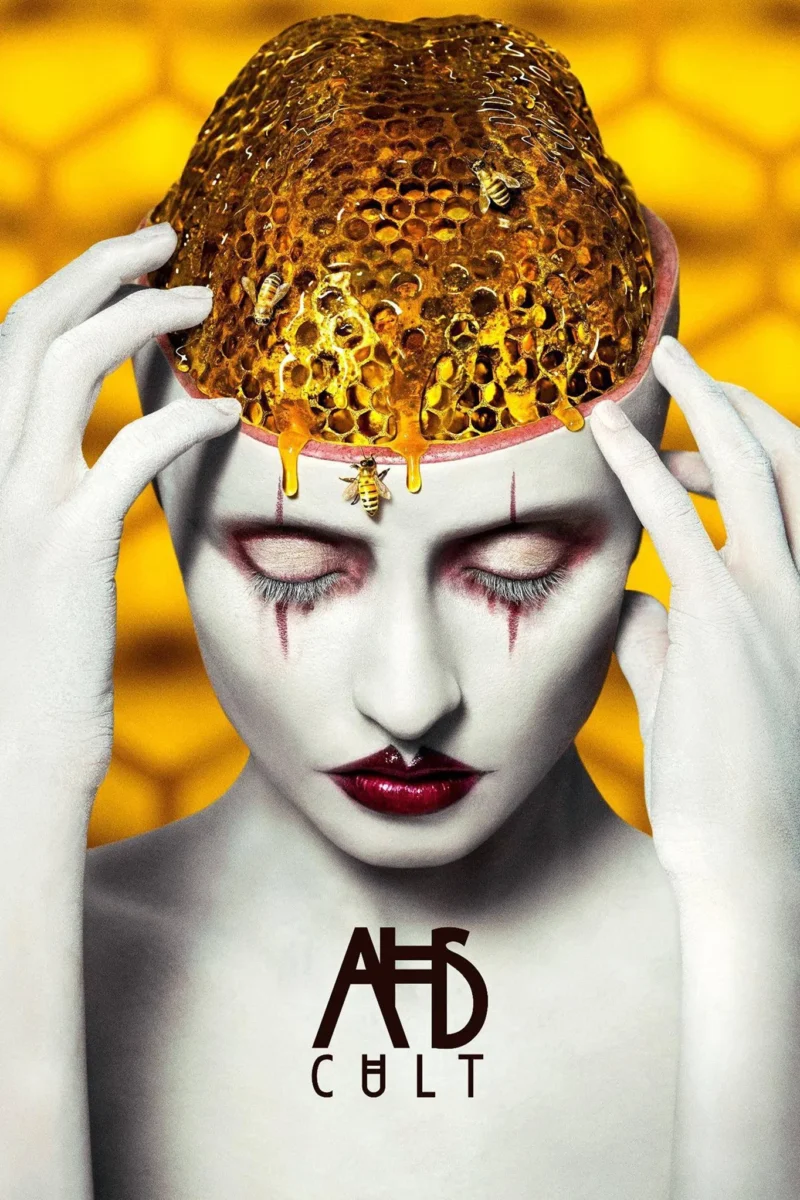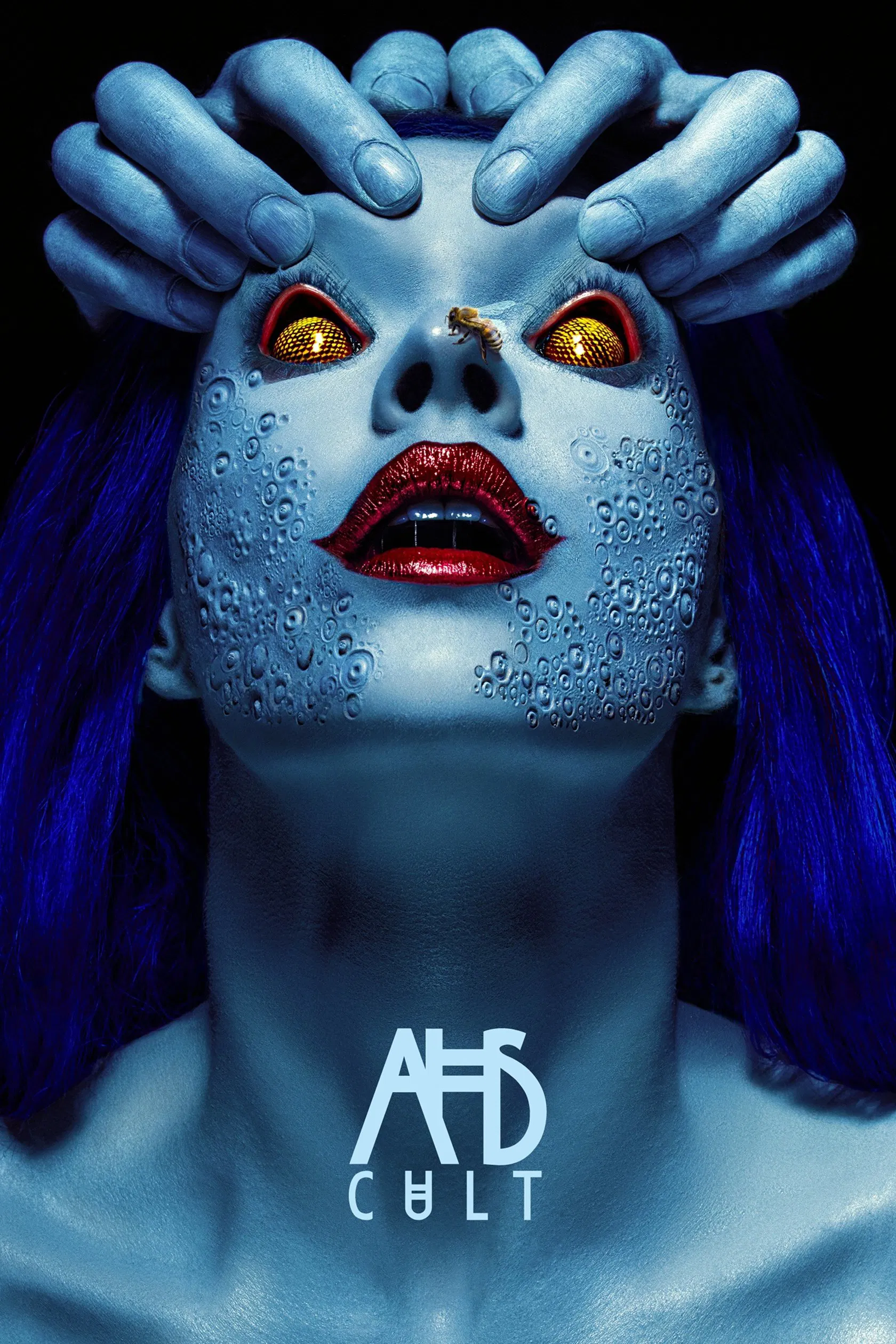
AHS: Cult is a little slice of 2016/17 wrapped in the most extreme paper possible. Watching it now feels like opening a time capsule that someone filled with cable news soundbites, red hats, and the gnawing anxiety that ran through every American dinner table. This is Murphy and Falchuk bottling the election of Donald Trump and the polarisation that swept the nation, then deciding the only logical way to explore it is through clowns, cult leaders, and Evan Peters going full messiah complex. It’s an unsubtle approach, but then again, subtlety is rarely what fans turn up for in this franchise.
The bones of the story are simple enough: fear grips the characters in the aftermath of Trump’s election win, and through that fear emerges Kai Anderson, played by Peters with unhinged precision. He’s blue-haired, magnetic, manipulative, and revels in becoming the self-styled “supreme leader.” Predictable? At times, yes. But Peters commits so fully that it becomes difficult not to get sucked into his orbit. He doesn’t just act like a cult leader; he channels them, retelling and re-staging infamous histories like the Manson Family. In a particularly surreal twist, Kai even hallucinates Charles Manson himself, bringing him into his psyche as a twisted spiritual guide. If there’s one reason to sit through the chaos, it’s Peters finding new shades of mania in every episode.
For those paying close attention, the show is riddled with nods and allusions that tie its fiction to real-world extremism. The Nazi parallels are there from the start—blink and you’ll miss a Luger P08 pistol when Sarah Paulson’s character, Ally Mayfair-Richards, frantically asks her neighbour for protection. That quick glimpse sets the tone, foreshadowing a season where symbols of fascism slide quietly into frame before exploding into the narrative. Kai’s blue-shirted followers feel like a deliberate parody of Hitler’s early SA, missing only a Röhm to complete the wink at history. It’s cartoonish, sure, but the comparison is clear, and the horror comes less from the clowns and gore and more from the uncomfortable echoes of the headlines we were all living through at the time.
Paulson plays Ally with the kind of neurotic intensity that only she can pull off, spiralling into fear and paranoia with such conviction you can’t help but root for her even when she’s at her most irrational. The paranoia of clowns stalking the suburbs is ridiculous, but the anxiety beneath it—the fear of the unknown, the distrust of your neighbours—feels painfully relevant. Ally’s panic attacks become the heartbeat of the season, grounding the spectacle in something that feels recognisably human.
But this being AHS, the show refuses to stay on one track (checkout AHS Hotel), pulling in yet another strand of extremism through the lens of Valerie Solanas and her radical manifesto, SCUM. In the hands of Murphy’s writers, Solanas’ ideas are exaggerated and stylised, reframed into a splinter group of violent man-haters who stand as a counterpoint to Kai’s all-male domination. On paper, it feels like another wild tangent, but thematically it adds weight. Where Kai represents the authoritarian urge to control through violence and fear, Solanas’ SCUM becomes the inverse—revolution through destruction, equally obsessed with purification and equally doomed by its own extremity.
AHS: Cult, is it too much?
This is where the contrast with Ally becomes fascinating. Caught between Kai’s manipulative cult of personality and the all-consuming rage of SCUM, Ally’s paranoia shifts into resilience. Her frantic fear early on, peppered with clown sightings and trembling breakdowns, becomes a weapon in its own right. She recognises the madness on both ends of the spectrum, and in doing so, her paranoia hardens into survival instinct. By the season’s end, Ally feels less like a victim and more like the last sane woman standing in a tug-of-war between two equally destructive visions of society.
The SCUM episodes are divisive, no doubt. Some viewers found them too far a leap, a detour from the already heavy-handed political satire. But they also serve as an important mirror: Cult isn’t really about Trump, Kai, or even the clowns. It’s about extremism in all its forms, the way fear fractures people into factions, and how quickly ideology can become theatre of the absurd. Valerie Solanas was a real person with a real manifesto, and here she becomes mythologised into the same hall of grotesques as Manson and Hitler. It’s messy, sensational, and often heavy-handed, but it’s also unmistakably American Horror Story.
By the time the narrative really starts to lock in, you find yourself surprisingly invested despite the predictability. Yes, it telegraphs some of its twists. Yes, it occasionally drowns its points in so much spectacle that you can’t see the nuance. But it also manages to pull you in with a grim fascination. The season plays like a horror-satire binge designed more for American audiences than for Europeans, who may watch the Trump-fuelled hysteria at arm’s length. Still, as a document of that cultural moment refracted through the funhouse mirror of AHS, it works.
Cult may not rank among the best entries in the series, but it succeeds at one thing: making the viewer uncomfortable by reminding them that the scariest monsters don’t come with fangs or claws. Sometimes they just need a microphone, a crowd, and a blue shirt. For that alone, it’s worth the watch, even if you leave it feeling like you’ve been shouted at for eleven hours straight.