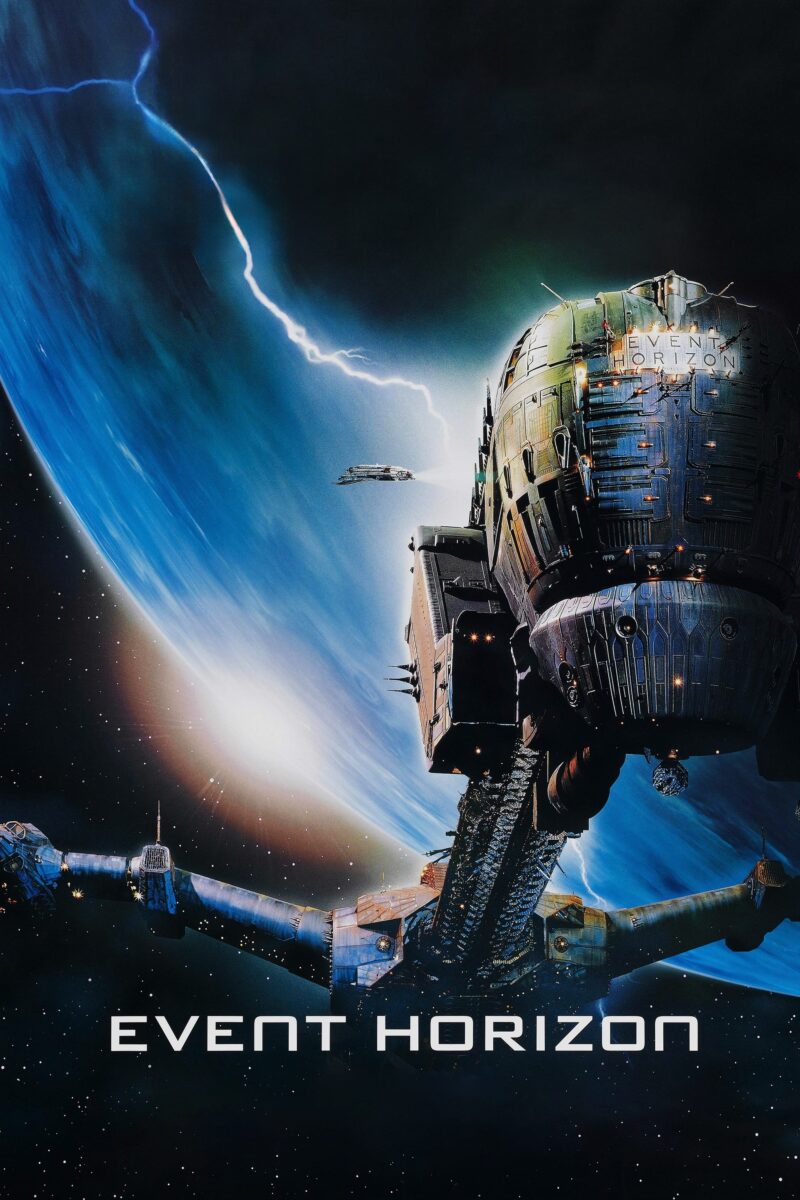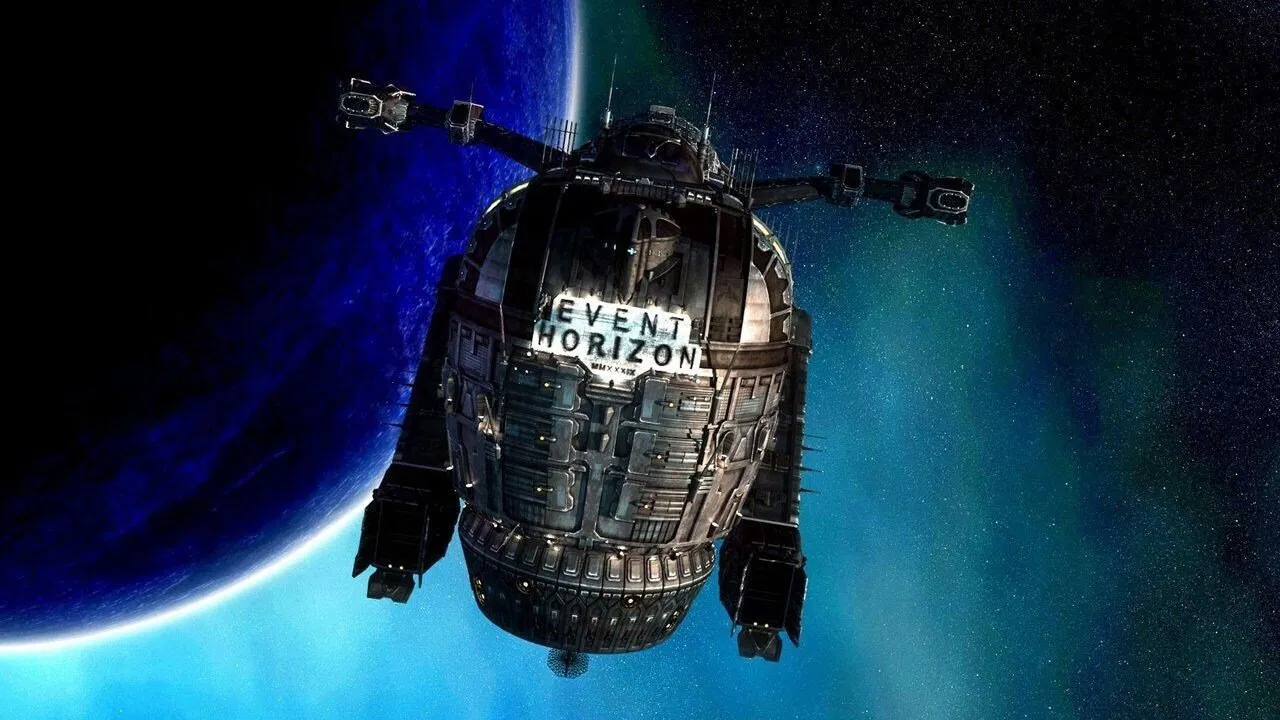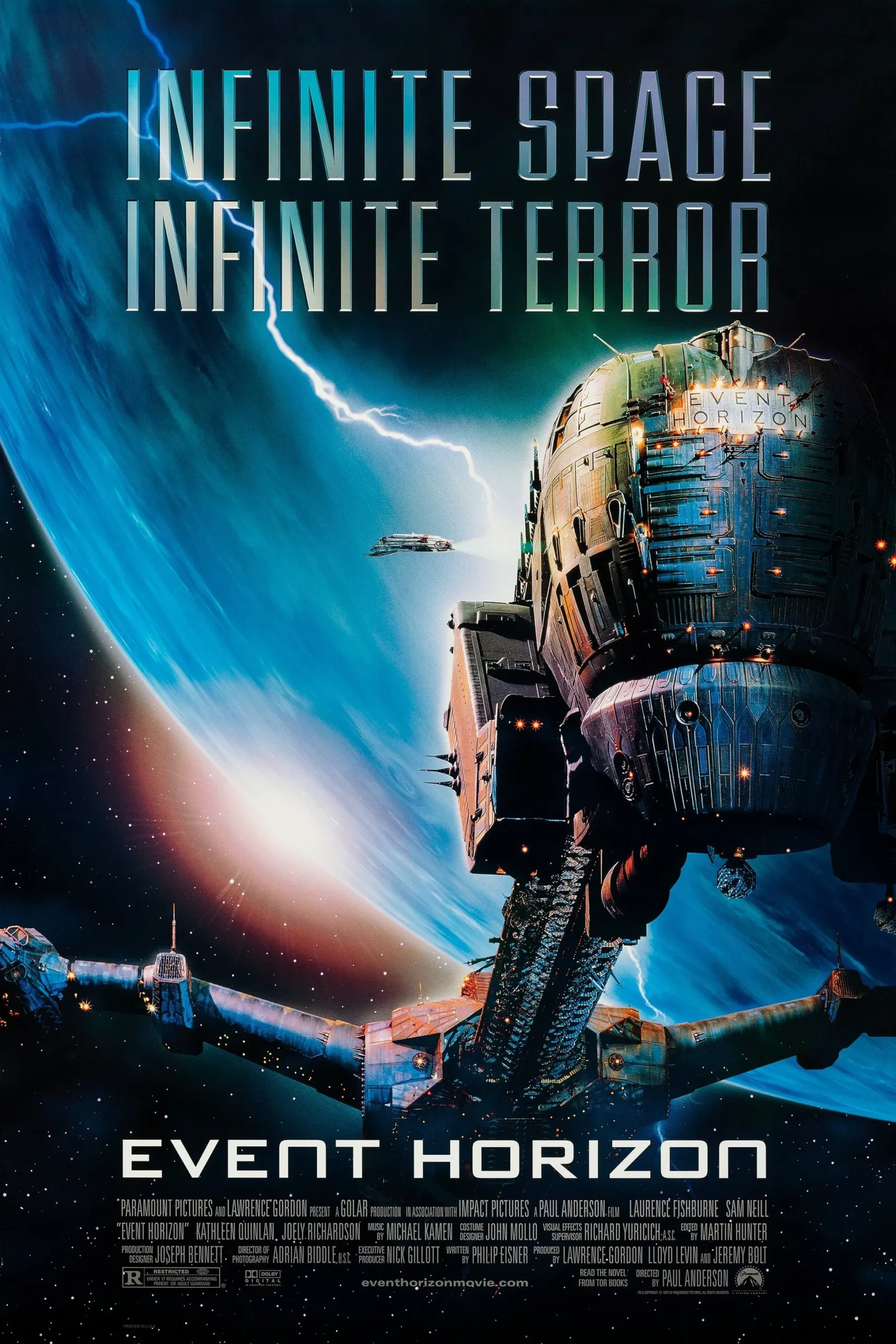
There are space films that look to the stars with wonder, optimism, and the spirit of discovery. Then there’s Event Horizon, which looks into the abyss and realises the abyss is looking back with a grin and a handful of Sam Neill’s eyeballs. Released in 1997, Paul W.S. Anderson’s interstellar horror gem takes the blueprint of Alien’s claustrophobic industrial design and cranks the dread up into cosmic horror territory. If Ridley Scott’s ship felt like a flying oil rig, Event Horizon’s titular vessel feels like a cathedral purpose-built to summon nightmares.
The premise is deceptively simple: a ship designed to bend space has reappeared after vanishing years before, and a rescue crew is sent to investigate. What could go wrong? Quite a lot, as it turns out. The “gravity drive,” a rotating, spiked monstrosity of a machine, opens doors that shouldn’t be opened, literally punching through the fabric of space and finding… something else. That “something” is never fully explained, but it doesn’t need to be. The suggestion alone that it could be a realm of Lovecraftian monstrosities—a dimension of chaos, pain, and madness—is enough to keep you glancing nervously at dark corners long after the credits roll.
Sam Neill anchors the film’s slow descent into insanity. His transformation from curious scientist to disciple of the void is both tragic and terrifying. There’s something about Neill’s natural warmth as an actor that makes his corruption all the more unnerving; when he stands eyeless, whispering about the beauty of pure chaos, it’s far more disturbing than if he’d been a cold villain from the outset. Laurence Fishburne plays the unflinching captain with real gravitas, giving us the kind of pragmatic, no-nonsense leader that grounds the terror in some sort of reality. Meanwhile, Jason Isaacs, Joely Richardson, and the rest of the supporting cast turn in genuinely solid performances that elevate the film beyond its B-movie trappings. Seeing Isaacs pre-Hogwarts, medical tools in hand instead of a wand, is a particularly fun treat.
What makes Event Horizon work so well is its commitment to mood and atmosphere. The production design leans heavily on industrial aesthetics, all steel bulkheads, claustrophobic corridors, and oppressive shadows. It’s easy to draw parallels with the grungy realism of Alien or the clanking futurism of Screamers, but Event Horizon goes one step further—its ship design has an almost gothic element to it, with arches, vaults, and corridors that resemble a twisted church. This ecclesiastical styling makes sense thematically; after all, what is cosmic horror if not a dark religion, worshipping the unexplainable?
Watching it today, it’s impossible not to notice how the ship’s design and unsettling corridors foreshadowed elements of Doctor Who’s “Wild Blue Yonder.” That episode’s distorted perspectives, uncanny silence, and oppressive spaces could be cousins to the Event Horizon’s labyrinthine passages. Both works tap into that primal fear of being alone in the dark—except you’re not really alone. Something is always just out of sight, waiting.
While Event Horizon leans into gore at times, it’s the unseen and the implied that really sells the terror. The fleeting visions of hellish torment, the sudden flashes of what the ship has brought back with it—these moments echo Lovecraft’s insistence that true horror lies not in what you can describe, but in what you can’t. The gravity drive doesn’t just take the crew to another dimension; it takes the viewer to the edge of their imagination, daring them to fill in the blanks.
Anderson’s direction has always been divisive, particularly after his Resident Evil years, but here it feels surprisingly restrained and focused. He doesn’t treat the film as a flashy effects showcase but instead allows atmosphere to do most of the heavy lifting. The pacing is deliberate, giving the horror time to seep in rather than erupt in cheap jump scares. Even the editing style adds to the unease, cutting quickly during hallucinations to suggest a violence too overwhelming to process in real time.
The legacy of Event Horizon is also shaped by what we didn’t get to see. Fans still whisper about the fabled “longer cut,” which reportedly contained even more graphic depictions of the hellish other-dimension sequences. The footage, rumour has it, was lost or destroyed, but the legend of it has become part of the film’s mystique. That absence works in the movie’s favour, ironically—it mirrors the unknowable horror at its core. Just as the Event Horizon brings back more questions than answers, the missing footage suggests horrors beyond what the screen could contain.
The film has earned its place as a cult classic precisely because it doesn’t over-explain itself. In an era when so much sci-fi is obsessed with technobabble and scientific justification, Event Horizon embraces mystery and terror. It’s messy, sure, and some of the CGI has aged like an old VHS tape left in the sun, but the core of the film remains unshakably effective. This isn’t about sleek futures or hopeful space exploration—it’s about the terrifying possibility that, in our eagerness to conquer the stars, we might stumble into something that was never meant to be found.
In the end, Event Horizon is a chilling blend of sci-fi and horror, a nightmare voyage that feels as if Ridley Scott and H.P. Lovecraft had a brainstorming session in a haunted boiler room. It’s industrial, it’s brutal, and it doesn’t let you off easy. For those who love their science fiction dark and their horror cosmic, this is a trip worth taking—just don’t expect to come back the same.