Stanley Kubrick’s Full Metal Jacket is a war film that’s half boot camp nightmare, half battlefield horror — and somehow entirely a commentary on the absurdity of it all. Released in 1987, this one pulls no punches, starting with a barber’s clippers buzzing over a fresh batch of recruits who have no idea they’re about to be torn down to atoms and rebuilt into so-called warriors. If you’ve never met a man who could reduce grown Marines to shivering schoolboys, say hello to R. Lee Ermey’s Gunnery Sergeant Hartman — a character who might just haunt your dreams shouting “Private Pyle!” until the end of days.
Our window into this dehumanising machinery is Matthew Modine’s Pvt. J.T. ‘Joker’ Davis, whose deadpan delivery and sardonic grin carry us through a tale split in two. The first act, set entirely within the suffocating walls of Parris Island boot camp, is so intense it could almost be its own short film. Vincent D’Onofrio, in a breakout role as Leonard ‘Gomer Pyle’ Lawrence, gives us one of the most tragic arcs in war cinema. Watching Pyle’s mental unraveling under Hartman’s relentless onslaught is both mesmerising and stomach-turning — a bleak reminder that the battlefield sometimes begins long before the front lines.
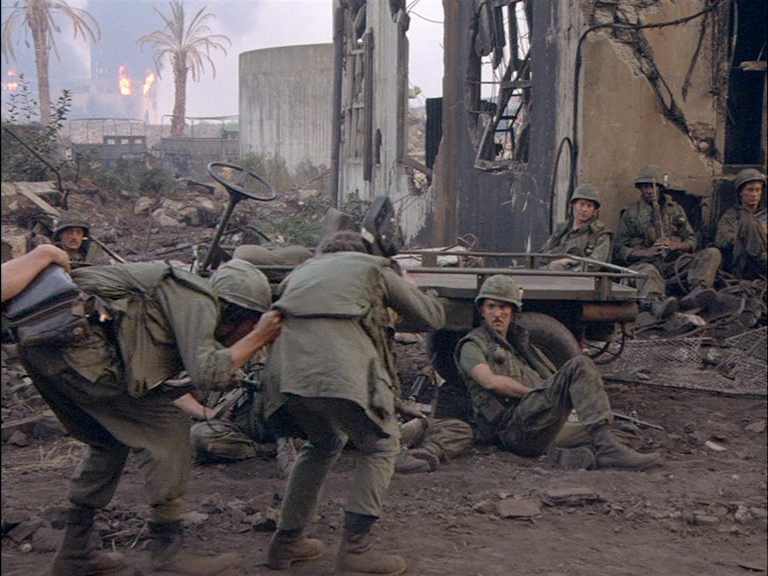
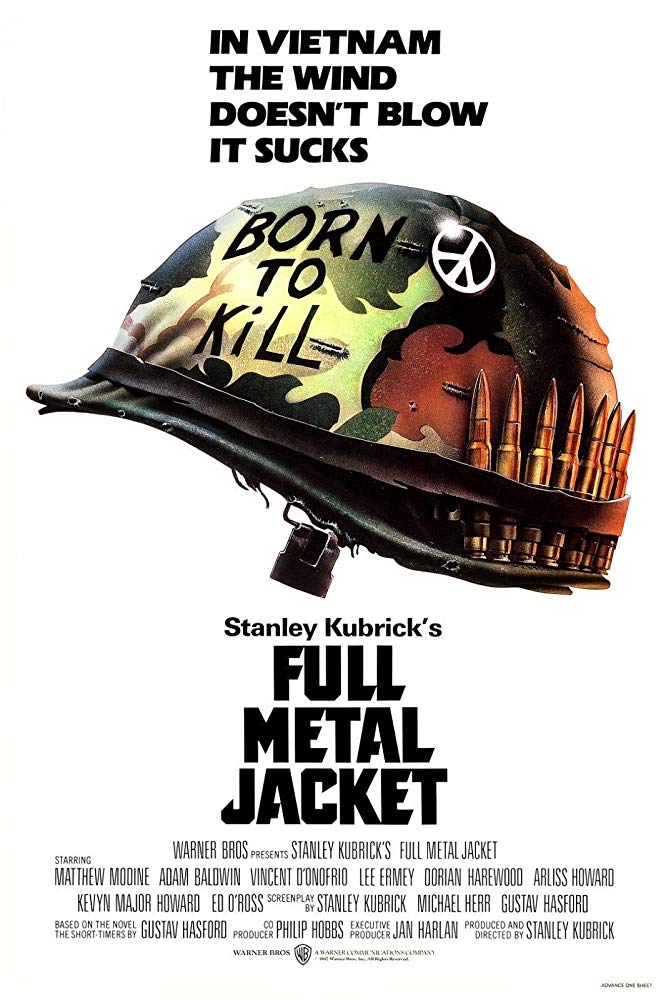
When the story shifts to the mean streets of Hue during the Tet Offensive, the tone transforms. Joker, now a war correspondent with a helmet that reads “Born to Kill” and a peace badge for extra irony, navigates the hypocrisy and futility that is the Vietnam War. There’s no hero’s charge here — just a surreal descent into urban warfare where the enemy could be anyone and the so-called good guys might be just as lost. The squad, including Arliss Howard’s Cowboy and Adam Baldwin’s Animal Mother, bring their own flavours of camaraderie and madness, but no one escapes Kubrick’s clinical lens.
Visually, Full Metal Jacket is trademark Kubrick: meticulously framed, often eerily symmetrical, and cold in a way that makes the horror feel disturbingly normal. The film’s soundscape — the whir of helicopter blades, the pop of rifle fire, and that nihilistic 60s soundtrack — stitches it all together, reminding you that while this is based on Gustav Hasford’s novel The Short-Timers, it’s Kubrick’s icy vision you’re really living in.
Yet for all its power, the film can feel uneven. The tonal shift between the Parris Island section and the Vietnam portion divides audiences to this day. Some argue the second half struggles to recapture the raw intensity of Hartman’s boot camp, losing its momentum amid Joker’s sardonic commentary and episodic structure. Maybe that’s the point — that war, at its core, is a fragmented nightmare that never quite adds up to heroics or glory.
At Camp Cape, Full Metal Jacket earns a solid 7/10. It’s a must-see for the genre, packed with lines that’ll echo in your brain and visuals that define the war film aesthetic. It’s also an uncomfortable watch that asks you to question the point of it all — because in Kubrick’s world, there rarely is one.
So grab your helmet, keep your soap in a sock (you’ll know why), and prepare for a ride through the meat grinder that is Kubrick’s Vietnam. Just remember: the real war is the one inside your head.